Working Principle and Performance Comparison of Reducer Types for Excavator Swing and Travel Motors
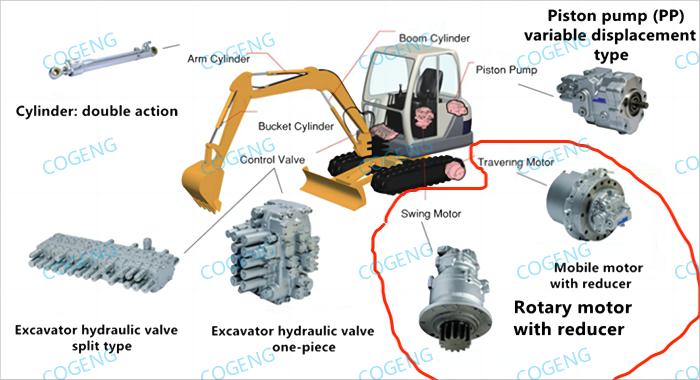
Understanding the gear reduction systems that transform high-speed hydraulic power into the torque your excavator needs.
When you pull the swing lever or push the travel pedals on an excavator, you’re commanding a hydraulic motor that spins at several thousand RPM with relatively modest torque. But what the machine actually needs at the turntable or track sprocket is massive torque at just a handful of RPM. Bridging this gap is the job of the reducer (gearbox)—a precision mechanical assembly that multiplies torque while reducing speed.
For excavator swing motors (rotating the upper structure) and travel motors (driving the tracks), engineers rely on specific reducer architectures, each with distinct working principles, performance characteristics, and maintenance profiles. Understanding these differences helps equipment owners make informed procurement decisions and diagnose failures accurately. For a full range of replacement swing and travel motor parts, visit https://cogeng.net/.
1. Why Reducers Matter in Excavator Hydraulic Systems
Hydraulic motors are optimised for high-speed, low-torque operation. Without reduction gearing, the motor would need to be impractically large to generate the torque required to swing a 20-tonne upper structure or push 30 tonnes of machine up a grade. The reducer performs three critical functions:
Torque Multiplication: Output torque = Motor torque × Reduction ratio (minus efficiency losses)
Speed Reduction: Output speed = Motor speed ÷ Reduction ratio
Load Holding: In many travel reducer designs, the geartrain provides inherent braking resistance against back-driving, supplementing the hydraulic counterbalance valve and mechanical parking brake.
2. Primary Reducer Types for Excavator Swing and Travel Applications
There are three principal reducer architectures used in excavator swing and travel drive systems. Each will be detailed with its working principle and performance profile.
| Reducer Type | Primary Application | Distinguishing Feature |
|---|---|---|
| Planetary Gear Reducer | Travel motors (final drive) and some swing motors | Multiple planet gears share load around a central sun gear |
| Cycloidal (Cyclo) Reducer | Swing motors on specific Japanese excavator brands | Lobed cam disc rolls inside a ring gear housing |
| Worm Gear Reducer | Limited use; older or compact swing drives | Worm screw drives a worm wheel at a 90° axis |
3. Planetary Gear Reducer: The Industry Workhorse
Working Principle
A planetary gear reducer consists of three main elements:
Sun Gear: The central gear, driven by the hydraulic motor input shaft.
Planet Gears: Multiple gears (typically three or four) that mesh with the sun gear and rotate around it. They are mounted on a common planet carrier.
Ring Gear (Annulus): An internal-toothed outer ring that meshes with the planet gears. In most travel reducers, the ring gear is fixed to the housing.
When the sun gear rotates, the planet gears walk around the inside of the fixed ring gear, driving the planet carrier to rotate at a reduced speed. Multiple planet gears share the transmitted load, distributing stress and enabling compact, high-torque-capacity designs.
Stages: Most excavator travel reducers use two or three planetary stages in series, with the carrier of one stage driving the sun gear of the next. This achieves overall reduction ratios from 30:1 up to 200:1 or more.
Performance Characteristics
| Parameter | Planetary Reducer |
|---|---|
| Reduction Ratio Range | 3:1 to 10:1 per stage; 30:1 to 200:1+ in multi-stage |
| Torque Density | Very high—the highest of any common reducer type |
| Efficiency | 95–98% per stage (excellent) |
| Backlash | Low to moderate (can be minimised with precision gears) |
| Back-Driving Capability | Possible unless combined with a brake |
| Noise Level | Moderate |
| Size/Weight | Compact and relatively lightweight for torque delivered |
| Serviceability | Generally excellent—individual gear sets and bearings are replaceable |
Common Excavator Applications
Travel Motor Final Drives: Virtually all modern excavators from Sumitomo, Hitachi, Kobelco, Caterpillar, and Komatsu use planetary final drives. The compact design fits within the track frame width, and the load-sharing of multiple planet gears handles the extreme shock loads of tracking over rough terrain.
Swing Motor Reducers: Many excavators, particularly those with high-cycle swing applications (demolition, material handling), use planetary swing reducers. They offer robust overload capacity for the inertial loads of starting and stopping a heavy upper structure.
Failure Modes to Watch
Planet gear bearing failure: Starved of oil, needle or roller bearings under planet gears seize, causing gear tooth damage.
Ring gear wear or fracture: Often caused by contamination or shock overload.
Sun gear shaft spline wear: Misalignment or lack of lubrication accelerates fretting wear on the input spline.
4. Cycloidal (Cyclo) Reducer: Compact Precision for Swing Drives
Working Principle
A cycloidal reducer operates on a fundamentally different principle than standard involute gearing:
An eccentric input shaft (driven by the hydraulic motor) rotates a lobed cycloidal disc (cam) .
This disc has an epitrochoidal profile—a series of lobes (e.g., 11 lobes) that mesh with a fixed ring gear containing one more pin or roller (e.g., 12 pins).
As the eccentric rotates, the cycloidal disc orbits inside the ring gear, advancing by one lobe per input revolution.
Output pins engage holes in the cycloidal disc, extracting the pure rotational component of the disc's motion and driving the output shaft.
The result is a very high reduction ratio in a single stage with multiple teeth sharing the load simultaneously.
Performance Characteristics
| Parameter | Cycloidal Reducer |
|---|---|
| Reduction Ratio Range | 10:1 to 100:1+ in a single stage |
| Torque Density | High—comparable to planetary within certain ranges |
| Efficiency | 85–93% (lower than planetary due to sliding friction) |
| Backlash | Can be extremely low (<1 arc-minute in precision models) |
| Back-Driving Capability | Generally poor; offers some inherent braking resistance |
| Noise Level | Low to moderate |
| Size/Weight | Very compact axially; diameter can be larger than planetary |
| Serviceability | More specialised; replacement of complete cartridge is common in the field |
Common Excavator Applications
Swing Motors on Kobelco and Some Sumitomo Models: Several Japanese excavator manufacturers have adopted cycloidal reducers for swing drives, valuing their compact axial length and high single-stage reduction ratios. The inherent back-driving resistance is also beneficial for swing holding on slopes.
Precision Industrial Robots (Reference): While not excavator-related, the widespread use of cycloidal reducers in industrial robot arms illustrates their strengths in compact, high-ratio, low-backlash applications.
Failure Modes to Watch
Cycloidal disc and pin wear: Contaminated oil accelerates abrasive wear on the disc lobes and ring gear pins, increasing backlash and eventually causing skipping.
Eccentric bearing failure: The high-speed eccentric input bearing is heavily loaded; failure here is a leading cause of complete reducer seizure.
Output pin mechanism wear: The pins and bushings that extract rotation from the cycloidal disc are a wear point.
5. Worm Gear Reducer: Simple but Limited in Modern Excavators
Working Principle
A worm gear reducer consists of a worm (screw) that meshes with a worm wheel (helical gear) , with the input and output shafts typically at 90° to each other. The sliding contact between the worm threads and wheel teeth provides high reduction ratios in a single stage.
Performance Characteristics
| Parameter | Worm Gear Reducer |
|---|---|
| Reduction Ratio Range | 5:1 to 100:1 in a single stage |
| Torque Density | Moderate |
| Efficiency | 40–85% (highly variable; declines sharply at high ratios) |
| Backlash | Moderate |
| Back-Driving Capability | Self-locking at ratios above ~30:1 (can be an advantage) |
| Noise Level | Very low (quiet operation) |
| Size/Weight | Bulky compared to equivalent planetary |
| Serviceability | Worm wheel replacement requires complete disassembly |
Common Excavator Applications
Limited Niche Use: Worm gear reducers are uncommon as the primary swing or travel reducer on modern excavators. Their lower efficiency and bulk work against them. They may be found on older small excavators, slew drives on some attachments, or special-purpose machinery where the self-locking characteristic (holding position without a brake) is valued and efficiency is a secondary concern.
6. Head-to-Head Performance Comparison
| Criteria | Planetary Reducer | Cycloidal Reducer | Worm Gear Reducer |
|---|---|---|---|
| Efficiency | ⭐⭐⭐⭐⭐ (95–98%/stage) | ⭐⭐⭐⭐ (85–93%) | ⭐⭐ (40–85%) |
| Torque Density | ⭐⭐⭐⭐⭐ | ⭐⭐⭐⭐ | ⭐⭐⭐ |
| Compactness | ⭐⭐⭐⭐⭐ | ⭐⭐⭐⭐ (short axially) | ⭐⭐ |
| Overload Capacity | ⭐⭐⭐⭐⭐ (shock loads shared) | ⭐⭐⭐⭐ | ⭐⭐⭐ |
| Backlash Control | ⭐⭐⭐ (good, not ultra-precise) | ⭐⭐⭐⭐⭐ (can be sub-arc-minute) | ⭐⭐⭐ |
| Inherent Braking | ⭐ (requires separate brake) | ⭐⭐⭐ (moderate resistance) | ⭐⭐⭐⭐ (self-locking at high ratio) |
| Ease of Field Service | ⭐⭐⭐⭐⭐ | ⭐⭐ (often cartridge replacement) | ⭐⭐ |
| Parts Availability | ⭐⭐⭐⭐⭐ (wide aftermarket) | ⭐⭐⭐ (brand-specific) | ⭐⭐⭐⭐ |
| Typical Excavator Use | Travel final drives, many swing drives | Swing drives (Kobelco, some Sumitomo) | Niche/legacy applications |
7. Choosing the Right Replacement Parts for Your Reducer
When maintaining or replacing a swing or travel reducer, these steps will help you source correctly:
Identify the Reducer Type
Physical shape: A cylindrical, multi-stage housing bolted to the track frame is almost certainly a planetary final drive. A disc-shaped swing reducer housing may be cycloidal or planetary.
Manufacturer tag: Record the complete model code and serial number from the reducer nameplate.
Common Wear Parts by Reducer Type
| Reducer Type | Typical Service Parts |
|---|---|
| Planetary | Sun gears, planet gears, planet bearings, ring gear, seals, thrust washers |
| Cycloidal | Cycloidal discs, ring gear pins, eccentric bearings, output pin assemblies, seals |
| Worm Gear | Worm wheel (gear), worm shaft, bearings, seals |
Procurement Tips
Oil analysis before failure: Metal in the final drive oil signals impending bearing or gear failure. Early intervention can save the housing and higher-stage gears.
Complete assembly vs. internal parts: If the housing bores or gear mounting surfaces are damaged, a complete reducer assembly is necessary. If only gears and bearings are worn, internal repair kits offer substantial savings.
Aftermarket quality: Quality aftermarket gear sets and bearing kits, such as those supplied through https://cogeng.net/, are manufactured to OEM-equivalent specifications and can reduce downtime costs significantly compared to dealer-only sourcing.
8. Maintenance Best Practices for All Reducer Types
Regardless of whether your machine uses planetary, cycloidal, or worm gear reducers, these principles extend service life:
Oil Level and Quality: Check final drive and swing reducer oil levels at the intervals specified in your machine's service manual. Milky oil indicates water ingress; metallic glitter indicates gear or bearing wear.
Seal Integrity: The duo-cone floating seals on travel motor final drives are wear items. Replace them at the first sign of external leakage to prevent contamination ingress and internal component destruction.
Break-In Oil Change: After any major reducer repair or replacement, change the oil after the first 50–100 operating hours to flush out initial wear particles.
Pressure Testing: On swing motor reducers, verify that the hydraulic crossover relief valves are functioning correctly. Excessive hydraulic shock loads accelerate reducer wear.
Summary Table: Quick Reference for Equipment Owners
| Your Machine Symptom or Need | Likely Reducer Type | Recommended Action |
|---|---|---|
| Track drive loss, metal in oil, compact cylindrical housing | Planetary travel final drive | Inspect planet gears and bearings; source repair kit or complete drive |
| Swing jerking or clunking, disc-shaped reducer housing on Kobelco/Sumitomo | Cycloidal swing reducer | Inspect cycloidal discs and pins; source cartridge or rebuild kit |
| Inability to hold position on slope without brake, worm/screw housing visible | Worm gear reducer | Inspect worm wheel wear; replacement likely required |
| Need a replacement reducer or internal parts | Any type | Visit https://cogeng.net/ to cross-reference your model |
Related Keywords for Search:
travel motor planetary gearbox working principle
cycloidal reducer vs planetary gear reducer
excavator final drive replacement
swing drive reducer comparison
hydraulic motor gearbox types
Kobelco swing motor reducer
Sumitomo excavator travel motor parts
COGENG reducer parts
Disclaimer: All excavator brand names and model designations are used for compatibility reference only. COGENG is an independent supplier of aftermarket replacement parts and is not affiliated with Sumitomo, Kobelco, Caterpillar, Komatsu, or Hitachi. Always consult your equipment service manual and a qualified technician for specific repair procedures.


Comments
Post a Comment