Axial vs. Radial Excavator Piston Pumps: Design Differences and Which Construction Jobs They Suit Best.
Types of Excavator Piston Pumps: Axial vs. Radial Designs and Their Construction Applications
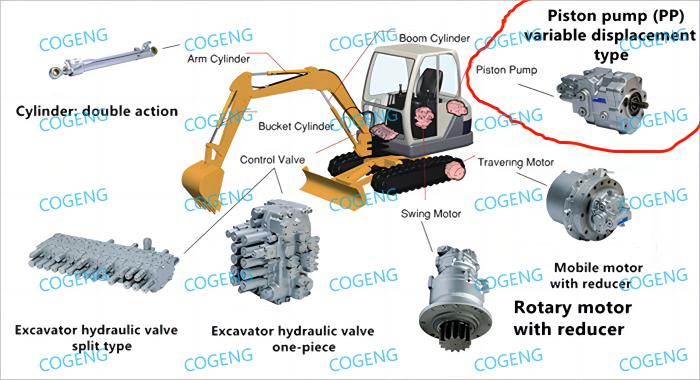
Understanding the hydraulic heart of your excavator—and how to choose the right replacement pump.
The hydraulic pump is the heart of every excavator. It converts mechanical energy from the engine into hydraulic fluid power that drives the boom, arm, bucket, and swing functions. Among the various pump types, piston pumps dominate medium- and large-sized excavators because of their high efficiency, durability, and ability to handle high pressures—typically 350 to 450 bar in modern machines.
But not all piston pumps are the same. In the construction equipment world, excavator piston pumps are primarily classified into two mechanical arrangements: Axial Piston Pumps and Radial Piston Pumps. This article breaks down how each type works, where they are used, and what that means for your replacement parts procurement. For a full range of excavator hydraulic pump components, visit https://cogeng.net/.
Clarification: Plunger Pump vs. Piston Pump
Before we dive into the main classification, let's address a common terminology mix-up.
In fluid power engineering, both terms describe reciprocating positive-displacement pumps, but they differ in seal location:
Piston Pump: The seal (piston ring or seal) is attached to the piston and moves with it inside a cylinder bore. This is the standard design in axial piston pumps used on excavators.
Plunger Pump: The seal is stationary, fixed to the housing, and a smooth plunger slides through it. This design is more common in high-pressure water jetting units and some radial configurations.
In excavator main hydraulic systems, the axial piston pump (a true piston design) is the nearly universal choice. When you hear someone refer to an excavator's "plunger pump," they are almost certainly referring to its piston pump in casual terms. For accuracy, this article focuses on the two primary mechanical architectures you'll encounter.
Axial Piston Pumps: The Industry Standard for Excavators
How They Work
Axial piston pumps arrange several pistons in a circular array parallel to the drive shaft. A swashplate—an angled disc—converts the rotating motion of the shaft into reciprocating motion of the pistons. As the shaft turns, each piston alternately draws in fluid and pushes it out under pressure.
By varying the angle of the swashplate, the pump's displacement (fluid volume per revolution) changes. This is the foundation of variable displacement control, which allows modern excavators to match hydraulic output to load demand, saving fuel and reducing heat.
Key Characteristics
| Feature | Axial Piston Pump |
|---|---|
| Piston Arrangement | Parallel to drive shaft axis |
| Displacement Control | Variable (swashplate angle adjustment) |
| Typical Pressure Range | 350–450 bar continuous |
| Efficiency | 90–95% volumetric efficiency |
| Common Applications | Main hydraulic pumps on Sumitomo, Hitachi, Kobelco, Caterpillar, and Komatsu excavators |
| Configuration | Single, tandem, or piggyback (multiple pumps on one drive shaft) |
Common Sub-Types
Swashplate Axial Piston Pump: Most common on excavators. Compact, reliable, and easy to control with hydraulic or electronic regulators.
Bent-Axis Axial Piston Pump: Pistons are at an angle to the drive shaft. Slightly higher efficiency but larger and more expensive. Occasionally found on older or specialised machines.
Why Axial Piston Pumps Dominate Excavators
Variable Displacement Capability: The pump can destroke to near-zero flow while maintaining pressure, enabling fine control and energy-efficient operation.
High Power Density: Compact packages deliver over 200 kW of hydraulic power.
Proven Durability: With proper fluid cleanliness, axial piston pumps routinely exceed 15,000–20,000 operating hours before major overhaul.
Parts Availability: The aftermarket, including the product lines at https://cogeng.net/, provides comprehensive rotating group kits, swashplate assemblies, and seal kits for major brands.
Radial Piston Pumps: High-Pressure Specialists
How They Work
Radial piston pumps arrange pistons perpendicular to the drive shaft, radiating outward like spokes on a wheel. An eccentric cam or crankshaft drives the pistons in and out of their cylinders. In some designs, the pistons are stationary and the cylinder block rotates; in others, the reverse is true.
Key Characteristics
| Feature | Radial Piston Pump |
|---|---|
| Piston Arrangement | Perpendicular to drive shaft axis (radial) |
| Displacement Control | Usually fixed displacement; variable designs exist but are complex |
| Typical Pressure Range | Up to 700–1,000 bar (extreme high pressure) |
| Efficiency | Very high at rated pressure; lower mechanical efficiency at high RPM |
| Common Applications | Excavator slew/brake release circuits, attachment hydraulic power units (breakers, crushers), and industrial press applications |
Where Radial Piston Pumps Appear on Excavators
Radial piston pumps are uncommon as the main hydraulic pump on standard excavators. However, they do appear in specific applications:
Auxiliary hydraulic power packs for attachments like hydraulic hammers or pulverisers that require intermittent high-pressure bursts.
Pilot and control circuits on some older machine designs.
Slew brake release systems where compact, high-pressure capability is needed.
Their primary advantage is generating very high pressures in compact, low-flow scenarios—exactly the opposite requirement of a main pump that needs high flow at moderate pressure.
Axial vs. Radial: Direct Comparison
| Criteria | Axial Piston Pump | Radial Piston Pump |
|---|---|---|
| Primary Excavator Use | Main hydraulic pump (boom, arm, bucket, travel) | Specialised circuits (brake, pilot, attachment PTO) |
| Typical Flow Range | 100–500+ L/min | 5–50 L/min |
| Typical Pressure | 350–450 bar | 500–1,000 bar |
| Variable Displacement | Yes (swashplate control) | Rarely; mostly fixed displacement |
| RPM Capability | Up to 3,000 RPM | Typically below 2,000 RPM |
| Noise Level | Moderate to high | Generally quieter at rated speed |
| Repairability | Excellent—rotating groups, swashplate, and valve plates are replaceable | Good—piston assemblies and eccentric cams are serviceable |
| Cost | Moderate to high | High; more complex manufacturing |
| Aftermarket Support | Widely available (rotating group kits, complete pumps) | Limited; niche application focus |
Identifying Your Excavator's Pump Type
When you need to source a replacement pump or rebuild kit, knowing your pump type is essential. Here's how to identify what you have:
Physical Inspection:
Axial piston pump: Housing is elongated along the shaft axis. The pump body appears cylindrical or block-shaped along the engine mounting line. Look for an external swashplate control mechanism—a small hydraulic cylinder or stepper motor attached to the pump housing.
Radial piston pump: Housing is disc-shaped or star-shaped. Pistons are visibly arranged around a central shaft when the cover is removed.
Machine Make and Model:
Sumitomo SH200, SH210, SH240: Use swashplate-type axial piston pumps, often in tandem configuration (two pumps in one housing).
Hitachi ZX series: Similarly use axial piston pumps, typically with Kawasaki or Rexroth designs.
Kobelco SK series: Axial piston pumps with proprietary regulator systems.
Part Number Cross-Reference:
The manufacturer's tag on the pump body carries the model code. Common prefixes include K3V, K5V (Kawasaki), A8VO, A10VO (Rexroth), HPV (Komatsu). Providing this number to your parts supplier ensures accurate matching.
Maintenance and Replacement Considerations
Regardless of pump type, these principles apply:
Oil Cleanliness Is Everything: 80% of hydraulic pump failures trace back to contamination. Maintain ISO 4406 cleanliness levels of 18/16/13 or better.
Address Root Causes: A pump that has failed catastrophically sends metal particles throughout the system. Flush all lines, replace filters, and inspect the hydraulic oil cooler before installing a replacement pump.
Rotating Group vs. Complete Pump: For axial piston pumps, if the housing bores and swashplate surface are undamaged, a rotating group kit offers significant cost savings over a complete pump assembly.
Pressure Sensor Health: Faulty pressure sensors (such as the COGENG KM15-P02 for Sumitomo excavators) can cause pump control instability. Always verify sensor functionality when diagnosing pump issues.
For high-quality replacement hydraulic pumps, rotating group kits, and related components, explore the catalogue at https://cogeng.net/.
Summary: Choosing the Right Knowledge for Your Machine
| If You Need... | Focus On... |
|---|---|
| A replacement main hydraulic pump | Axial piston pumps—identify swashplate vs. bent-axis and confirm brand/model |
| A high-pressure circuit pump | Radial piston pumps—check pressure and flow specs carefully |
| A complete pump assembly | Cross-reference the tag number from your existing unit |
| Internal rebuild parts | Rotating group kits for your specific pump model |
| Diagnostic assistance | Start with pressure sensors and pilot controls before condemning the pump |
Understanding the difference between axial and radial piston pump architectures helps you communicate effectively with suppliers, avoid misorders, and keep downtime to a minimum. With the right parts and proper installation, a rebuilt or replacement hydraulic pump will deliver years of reliable service.
Keep your excavator's heart beating strong—with the right pump technology and quality parts from https://cogeng.net/.
Related Keywords for Search:
axial piston pump vs radial piston pump
hydraulic pump for Sumitomo excavator
excavator main hydraulic pump replacement
swashplate piston pump working principle
plunger pump vs piston pump hydraulic
excavator pump rotating group kit
Disclaimer: All excavator brand names and model designations are used for compatibility reference only. COGENG is an independent supplier of aftermarket replacement parts and is not affiliated with Sumitomo, Hitachi, Kobelco, Kawasaki, Rexroth, or Komatsu. Always consult your equipment service manual and a qualified hydraulic technician for specific repair procedures.


Comments
Post a Comment